
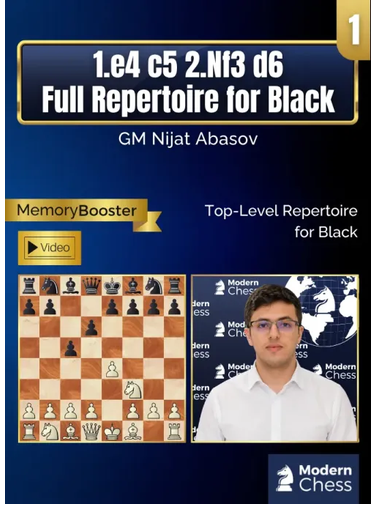
1.e4 c5 2.Nf3 d6 – Full Repertoire for Black – Part 1 + PGN June 17, 2026
Original price was: $ 100.$ 5Current price is: $ 5.
OFF - 95%In stock

Description
Reviews (0)
Description
| Category | Modern Chess, PREMIUM CHESS VIDEO |
|---|
The Najdorf for Black — A Top Level Repertoire — Part 1, by GM Nijat Abasov
For years, Nijat Abasov was known at the board as a Sveshnikov player. The Najdorf was something he kept to the side — studied closely, valued, but rarely shown in his own games. This course is where that private repertoire finally comes into the open, and by his own admission, it is the point where the opening crosses over from his preparation into his tournament play.
That openness is the heart of Abasov’s debut on Modern Chess. He is not selling a system he was handed; he is opening a folder he has kept to himself, explaining in his own words why, after a career built on a different Sicilian, the Najdorf is the line he keeps returning to.
A first course from a World Cup semifinalist
GM Nijat Abasov reached a peak rating of 2679 and the world’s top 60 in October 2023 — the same season as the run that defined his reputation. Seeded 69th at the 2023 FIDE World Cup, he eliminated Anish Giri, Peter Svidler, and Vidit Gujrathi on his way to the semifinals, a fourth-place finish that earned him a seat at the 2024 Candidates Tournament.
This is his first published course, and he treats it that way: carefully, and with the sense of someone presenting work he genuinely cares about.
Why the Najdorf, in the author’s own words
Abasov is direct about the comparison that matters most to him. Having played the Sveshnikov for years, he points to two things the Najdorf does better — a far wider variety of viable setups for Black, and noticeably fewer forced drawing lines that White can steer into.
He also frames it dynamically. In his view the Najdorf is the most ambitious Sicilian and the most double-edged: the resulting positions rarely allow White an easy path to equality, and unlike some lines where Black accepts a slightly passive stance, Black’s chances here are not objectively worse in most cases.
What Part 1 covers
Part 1 deals with everything before the heart of the Open Sicilian theory — the ways White tries to sidestep it, and the full menu of sixth moves in the main tabiya (excluding 6.h3, 6.Be3, and 6.Bg5, which belong to the deeper main lines). After 1.e4 c5 2.Nf3 d6, the recommendations are built around clarity for Black: against the Moscow Variation, for instance, Abasov suggests the simpler 3…Bd7, noting that the more ambitious 3…Nd7 carries greater risk.
Variation map — Part 1
1.e4 c5 2.Nf3 d6
- 3.Bc4 and related move-3 tries → Chapter 1
- 3.c3 — the Delayed Alapin → Chapter 2
- 3.Bb5+ Bd7 — the Moscow Variation
- 4.c4 and other 4th-move tries → Chapter 3
- 4.Bxd7+ — the critical main line → Chapter 4
3.d4 cxd4
- 4.Qxd4 — the queen recapture → Chapter 5
- 4.Nxd4 Nf6 5.Nc3 — deviations such as 5.f3 and 5.Bd3 → Chapter 6
5…a6 — the Najdorf tabiya (sixth moves)
- 6.Qd3 and other rare continuations → Chapter 7
- 6.Rg1 — the “Freak Attack” → Chapter 8
- 6.a4 → Chapter 9
- 6.g3 — Fianchetto systems → Chapter 10
- 6.Be2 — the Classical → Chapter 11
- 6.f4 — revived among top players since late 2025 (Van Foreest–Carlsen) → Chapter 12
- 6.Bd3 — White’s modern try, intending 7.Nde2 → Chapter 13
- 6.Bc4 — the Sozin Attack, once Fischer’s weapon → Chapter 14
Reviews (0)
Leave a Reply
You also like

The Elegant English – Part 2 Chessable
Original price was: $ 100.$ 5Current price is: $ 5. Quick ViewAdd to cart
How to Find Positional Chess Sacrifices with IM Asaf Givon
Original price was: $ 100.$ 5Current price is: $ 5. Quick ViewAdd to cart
IM Christof Sielecki 33 Chess Concepts that took down World Champions (MP4)
Original price was: $ 100.$ 5Current price is: $ 5. Quick ViewAdd to cart
Calculation Workshop with FM Viktor Neustroev (MP4)
Original price was: $ 100.$ 5Current price is: $ 5. Quick ViewAdd to cart
A World Champion’s Repertoire against the Queen’s Gambit Declined by Robert Ris (MP4)
Original price was: $ 100.$ 5Current price is: $ 5. Quick ViewAdd to cart
7 The Paco Vallejo Method – GM Paco Vallejo
Original price was: $ 100.$ 5Current price is: $ 5. Quick ViewAdd to cart
ChessMood In GM Avrukh’s Mind
Original price was: $ 100.$ 5Current price is: $ 5. Quick ViewAdd to cart
ChessBase Magazine #214 Full Version & SDVL
Original price was: $ 100.$ 5Current price is: $ 5. Quick ViewAdd to cart
Reviews
There are no reviews yet.