
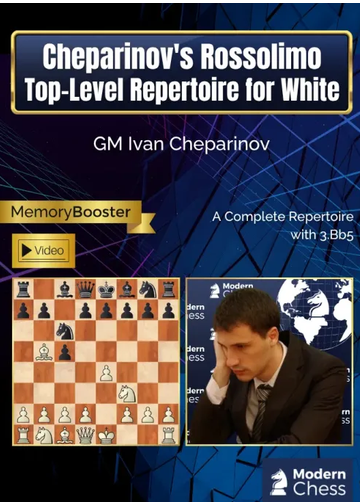
Cheparinov’s Rossolimo – Top-Level Repertoire for White + PGN June 30, 2026
Original price was: $ 100.$ 5Current price is: $ 5.
OFF - 95%In stock

Description
Reviews (0)
Description
| Category | Modern Chess, PREMIUM CHESS VIDEO |
|---|
Cheparinov’s Rossolimo – Top-Level Repertoire for White
Rare in the databases, proven at the board
At the 2025 FIDE Grand Swiss, Ivan Cheparinov faced Hans Niemann in the main line of the Rossolimo and answered the position with 7.a4 — a move with almost no pedigree in the databases. What followed was a comfortable, slightly better game for White: precisely the kind of edge this opening is built to produce.
That game is not an anecdote. It is the thesis of the whole course. Instead of wandering into the endless theory of the Open Sicilian, White steers the game onto ground he understands better than his opponent — structures and plans that have to be solved over the board, often without a clear map.
A repertoire built on staying in your own territory
The Rossolimo begins 1.e4 c5 2.Nf3 Nc6 3.Bb5, and Cheparinov’s recommendations consistently favour low-risk, low-theory lines that still pose real problems.
Against the main 3…g6 he castles first and inserts 5.Re1, waiting for …e5 before committing the structure. Against 3…e6 he chooses the immediate 4.Bxc6, then d3 and the rare 6.b3 — placing the bishop on b2 and preparing f4 in a line that has almost no games but plenty of venom.
The headline is that 7.a4 in the 3…g6, 5…e5 main line: queenside space, a fixed pawn target, and the plan Na3–c4 striking at both the e5-pawn and the dark squares. It is new, principled, and stress-tested at elite level by the author himself.
The author and his reasoning
Ivan Cheparinov is among the strongest practitioners of these positions, and the course reflects a working grandmaster’s priorities — lines that are easy to handle for White, awkward to meet for Black, and that hold the practical initiative even when the engine calls it roughly level.
Where he leaves the main roads — 4.e5 against 3…Nf6, 6.b3 against the 3…e6 line, 7.a4 against …e5 — he explains why the quieter path poses more problems for less risk. The result is a repertoire you can lean on anytime, because the understanding does the work that memorization usually has to.
What’s inside
- 9 chapters
- 20 test positions
- Memory Booster
- To Go version of every chapter
- Video instruction
- Multilingual PGN (English, German, French, Spanish)
Variation map
1.e4 c5 2.Nf3 Nc6 3.Bb5
3…g6 4.O-O Bg7 5.Re1
- 5…e5 6.Bxc6 dxc6 7.a4 → Chapter 9
- 5…e5 6.Bxc6 bxc6 7.c3 → Chapter 9
- 5…Nf6 6.Bxc6 dxc6 → Chapter 8
- 5…d6 6.e5 → Chapter 7
3…e6 4.Bxc6 bxc6 5.d3
- 5…Qc7 6.b3 → Chapter 6
- 5…Ne7 and other 5th moves → Chapter 5
3…d6 4.O-O Bd7 5.Re1 → Chapter 4
3…Nf6 4.e5 → Chapter 3
3…e5 4.O-O → Chapter 2
3…rare third moves → Chapter 1
Going deeper into the structures
Cheparinov’s repertoire revolves around the exchange on c6, and the resulting positions reward a player who understands the pawn structures rather than merely recalling moves. GM Evgeny Romanov’s two-part Rossolimo middlegame series is a natural complement here: Middlegame Understanding – Rossolimo Structures – Part 1 covers the …bxc6 recapture, and Part 2 covers the …dxc6 structure.
They are not formal companion volumes to this course, but they deepen exactly the understanding these positions demand — and they are written for players who want to handle the Rossolimo with either colour.
Reviews (0)
Leave a Reply
You also like
Killer Instinct Conversion in the Endgame
Original price was: $ 100.$ 5Current price is: $ 5. Quick ViewAdd to cart
ChessMood In GM Avrukh’s Mind
Original price was: $ 100.$ 5Current price is: $ 5. Quick ViewAdd to cart
ChessBase Magazine #214 Full Version & SDVL
Original price was: $ 100.$ 5Current price is: $ 5. Quick ViewAdd to cart
A World Champion’s Repertoire against the Queen’s Gambit Declined by Robert Ris (MP4)
Original price was: $ 100.$ 5Current price is: $ 5. Quick ViewAdd to cart
The modern Grand Prix Attack – Trent SDVL & PGN
Original price was: $ 100.$ 5Current price is: $ 5. Quick ViewAdd to cart
Calculation Workshop with FM Viktor Neustroev (MP4)
Original price was: $ 100.$ 5Current price is: $ 5. Quick ViewAdd to cart
The Elegant English – Part 2 Chessable
Original price was: $ 100.$ 5Current price is: $ 5. Quick ViewAdd to cart
How to Find Positional Chess Sacrifices with IM Asaf Givon
Original price was: $ 100.$ 5Current price is: $ 5. Quick ViewAdd to cart
Reviews
There are no reviews yet.