
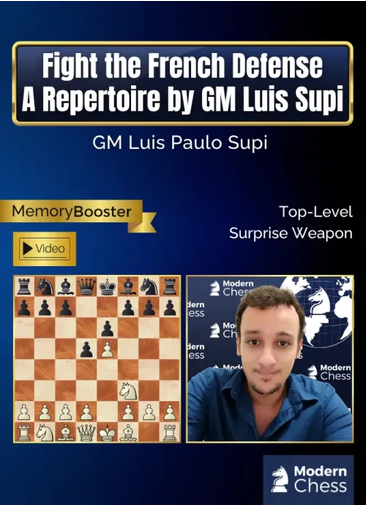
Fight the French Defense – A Repertoire by GM Luis Supi + PGN June 16, 2026
Original price was: $ 100.$ 5Current price is: $ 5.
OFF - 95%In stock

Description
Reviews (0)
Description
| Category | Modern Chess, PREMIUM CHESS VIDEO |
|---|
Fight the French Defense — A Repertoire by GM Luis Supi
A bishop that never belonged on b5 — until now
Some ideas survive a century of theory precisely because nobody thinks to question them. The bishop’s natural squares in the French Advance are d3, e2, and occasionally b5 only after the pawn structure has settled. In Fight the French Defense — A Repertoire, GM Luis Supi asks a simpler, sharper question: what if the bishop arrives on b5 before White has even played d4? The answer reorganizes an entire branch of the French around a single, unexpected move.
What makes the repertoire different
The repertoire is built on a move order rather than a single line. After 1.e4 e6 2.Nf3 — innocuous enough, since White retains every transposition into familiar Advance territory — Supi steers the game toward 2…d5 3.e5 c5 4.c3, and only then unveils the point: 5.Bb5!? against 4…Nc6. The bishop sortie is not a gambit or a trick; it is a structural reframing that poses fresh strategic problems Black has had no reason to prepare for.
What gives the idea its weight is that the move order does double duty. Reaching the same structures with the knight already committed to f3 quietly removes some of Black’s most reliable counters in the main lines — including recent fashions such as the early …Qa5 plan seen in Jordan van Foreest’s games. Supi’s verdict, after his own analysis, is that there is simply no clean equalizing route for Black here. The work covers the principled tries in turn: the critical 4…Qb6 complex (which Supi notes accounts for the majority of the French), the solid-looking 4…Bd7, and the main path with 4…Nc6 5.Bb5.
Author and inspiration
GM Luis Supi traces the idea to a practical source rather than an engine line. He first encountered the bishop sortie in a game by his friend GM José Martínez Alcántara, was intrigued enough to analyze it independently, and came away convinced the move was deeper and more durable than its modest appearance suggests. A second, practical benefit runs through the course: players who already favor the Advance Variation can implement this move order into an existing repertoire without learning a new system from scratch.
Map of variations
1.e4 e6 2.Nf3 d5 3.e5 c5 4.c3
4…Nc6 5.Bb5!? — the main recommendation; fresh strategic problems with the bishop on b5
- 5.d4 — transposes to the standard French Advance, sidestepping recent …Qa5 ideas (not the repertoire’s choice)
4…Qb6!? — a principled try, met with an independent fresh suggestion
4…Bd7 — playable, but concedes the entire Qb6 complex; handled with its own dedicated treatment
What’s inside
- 4 theoretical chapters
- 8 exercises
- 10 test positions
- 6 model games
- Memory Booster
- Video instruction
- Multilingual PGN availability (English, German, French, Spanish)
Reviews (0)
Leave a Reply
You also like

30 Fundamental Classical Games with GM Renato Quintillano
Original price was: $ 100.$ 5Current price is: $ 5. Quick ViewAdd to cart
IM Christof Sielecki 33 Chess Concepts that took down World Champions (MP4)
Original price was: $ 100.$ 5Current price is: $ 5. Quick ViewAdd to cart
3 The Lenderman Method 1 – GM Aleksandr Lenderman
Original price was: $ 100.$ 5Current price is: $ 5. Quick ViewAdd to cart
Killer Instinct Conversion in the Endgame
Original price was: $ 100.$ 5Current price is: $ 5. Quick ViewAdd to cart
A World Champion’s Repertoire against the Queen’s Gambit Declined by Robert Ris (MP4)
Original price was: $ 100.$ 5Current price is: $ 5. Quick ViewAdd to cart
Lifetime Repertoires The Nimzo-Ragozin – Sielecki Chessable
Original price was: $ 100.$ 5Current price is: $ 5. Quick ViewAdd to cart
Erwin’s Opening Lab : The Cozio Defense Chessable
Original price was: $ 100.$ 5Current price is: $ 5. Quick ViewAdd to cart
Queen’s Gambit Accepted – Simple Solution to 1.d4 by GM Grigor Grigorov, GM Petar G. Ar...
Original price was: $ 100.$ 5Current price is: $ 5. Quick ViewAdd to cart
Reviews
There are no reviews yet.