
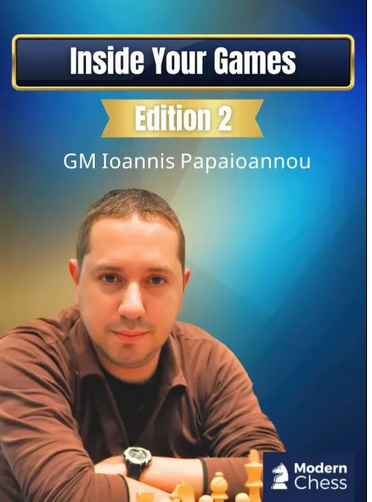
Inside Your Games – Edition 2 January 31, 2026
Original price was: $ 100.$ 5Current price is: $ 5.
OFF - 95%In stock

Description
Reviews (0)
Description
| Category | Modern Chess, PREMIUM CHESS VIDEO |
|---|
♟️ Inside Your Games – Edition 2
How Strong Players Actually Think
Inside Your Games – Edition 2 is not a course about perfect moves.
It is a course about real thinking, in real games, under real conditions.
As GM Ioannis Papaioannou explains, the goal of this project is simple but rare:
to show how a strong player evaluates positions, forms plans, and makes decisions — not how a chess engine assigns numbers to moves.
The games in this course are real games, played by members of the Modern Chess Academy.
They were not chosen for their beauty or accuracy, but for something far more valuable:
👉 They contain the typical decision-making moments where games are actually decided.
This second edition builds naturally on the foundation laid in
Inside Your Games – Edition 1
🔗 https://www.modern-chess.com/course/inside-your-games-edition-1/74626/
While the philosophy remains the same, Edition 2 introduces a new set of games, new structures, and fresh decision-making problems drawn from the practical experience of Academy members.
🧠 What is the Philosophy Behind the Approach of Papaioannou
In this project, no chess engine was used.
This is a deliberate and essential choice.
Engines are powerful tools, but they often hide the most important part of chess improvement:
the human thinking process.
Over the board, we do not calculate like machines.
We rely on pawn structure, piece coordination, experience, plans, and practical judgment.
That is exactly what GM Papaioannou focuses on.
Instead of telling you “the best move”, he explains how the position should be evaluated, which plans matter, where decisions become critical, and why certain ideas fail while others succeed.
If this course helps you start asking better questions during your own games, it has achieved its purpose.
📚 Course Structure
The course is divided into three complementary sections, each serving a distinct role in the learning process.
🔍 SECTION A — Annotated Games (Human Thinking)
This section contains 15 fully annotated games, all played by members of the Modern Chess Academy.
These games were selected because they feature typical strategic problems, recurring misunderstandings, and common decision-making errors.
The focus is not on isolated mistakes.
Instead, GM Papaioannou explains how positions should be evaluated, how plans emerge from pawn structure, and how piece coordination guides decisions.
The annotations follow the video explanations closely and intentionally avoid engine-based corrections, preserving the logic of human thought.
By studying these games, you will learn to recognize recurring thinking errors, understand why decisions go wrong, and improve the quality of your own choices in similar positions.
⏸️ SECTION B — Test Positions (Active Thinking)
During the analyses, you are often invited to pause and think.
All such moments are collected in this section.
Here, you are asked to evaluate the position, identify the relevant plans, and make a decision before seeing the continuation.
This active thinking is essential for turning understanding into real improvement.
📖 SECTION C — Knowledge Base (Pattern Recognition)
The final section contains reference games taken from existing Modern Chess training camps.
Some of these games may already include annotations from those camps.
Their purpose here is not deep explanation, but reinforcement through pattern recognition.
After working through the critical moments yourself, you compare how strong players handle similar pawn structures and strategic themes across different positions.
📖 SECTION C — Knowledge Base (Pattern Recognition)
The final section contains reference games taken from existing Modern Chess training camps.
Some of these games may already include annotations from those camps.
Their purpose here is not deep explanation, but reinforcement through pattern recognition.
After working through the critical moments yourself, you compare how strong players handle similar pawn structures and strategic themes across different positions.
Reviews (0)
Leave a Reply
You also like
How to Find Positional Chess Sacrifices with IM Asaf Givon
Original price was: $ 100.$ 5Current price is: $ 5. Quick ViewAdd to cart
Chessbase Play the Pirc like a Grandmaster Vol. 1: Positional lines CBFT
Original price was: $ 100.$ 5Current price is: $ 5. Quick ViewAdd to cart
Chessbase Key Concepts of Chess – Pawn Structures by Herman Grooten Volumes 1 and 2 This is...
Original price was: $ 100.$ 5Current price is: $ 5. Quick ViewAdd to cart
Calculation Workshop with FM Viktor Neustroev (MP4)
Original price was: $ 100.$ 5Current price is: $ 5. Quick ViewAdd to cart
The Elegant English – Part 2 Chessable
Original price was: $ 100.$ 5Current price is: $ 5. Quick ViewAdd to cart
3 The Lenderman Method 1 – GM Aleksandr Lenderman
Original price was: $ 100.$ 5Current price is: $ 5. Quick ViewAdd to cart
Lifetime Repertoires The Nimzo-Ragozin – Sielecki Chessable
Original price was: $ 100.$ 5Current price is: $ 5. Quick ViewAdd to cart
Killer Instinct Conversion in the Endgame
Original price was: $ 100.$ 5Current price is: $ 5. Quick ViewAdd to cart
Reviews
There are no reviews yet.