
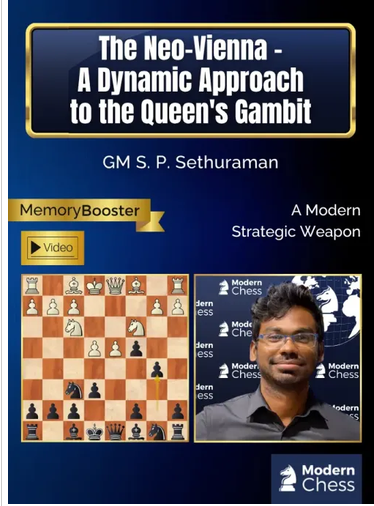
The Neo-Vienna – A Dynamic Approach to the Queen’s Gambit + PGN June 23, 2026
Original price was: $ 100.$ 5Current price is: $ 5.
OFF - 95%In stock

Description
Reviews (0)
Description
| Category | Modern Chess, PREMIUM CHESS VIDEO |
|---|
The Neo-Vienna: Grischuk’s Shortcut to a Sharper Queen’s Gambit
For decades, the Vienna Variation asked Black to walk a tightrope. After 1.d4 Nf6 2.c4 e6 3.Nf3 d5 4.Nc3 dxc4 5.e4, the classical road was 5…Bb4, holding the tension with the pin on c3 and the standing threat of …Nxe4. It worked, but it came wrapped in a thick layer of forcing theory that every well-booked opponent had seen.
Alexander Grischuk reframed the question. Rather than creating and maintaining the tension, why not resolve it at once with 5…b5 — clamping down on the c4-pawn immediately, even before it is properly defended. The point is refreshingly direct: provoke e5, open the b7–h1 diagonal, and develop with …Bb7 and …Nc6 at full speed. Material becomes secondary; time, coordination, and pressure on d4 are what matter. The Neo-Vienna – A Dynamic Approach to the Queen’s Gambit by GM S. P. Sethuraman is built around exactly this idea.
What sets the course apart
Sethuraman’s case for the Neo-Vienna is partly strategic and partly practical. The strategic appeal is that Black often reaches a superior version of the Botvinnik structure: because there is no pawn on c6 blocking the long diagonal, the b7-bishop enjoys a free range its Botvinnik cousin never gets.
The practical appeal is the time saved. The early …b5 sidesteps the heavy mainline theory after 5…Bb4 and steers the game toward rich, fightable middlegames where understanding outweighs memorization. After the typical 6.e5 Nd5 7.Nxb5 Nb6, Black accepts a slightly loose c4-pawn in exchange for the better minor pieces and a clear plan: …Nc6 hitting d4, …Be7, …Bb7, and the timely …Nb4 (against Qc2) or …Na5 (if White meets it with a3), the knight supporting c4 and eyeing the weakened b3-square.
Map of variations
1.d4 Nf6 2.c4 e6 3.Nf3 d5 4.Nc3 dxc4 — and now White’s choices:
5.a4 / 5.Bg5 / 5.g3 (fifth-move sidelines)
- Met by …Nc6 and the …a6/…b5 setups → Chapter 1
5.Qa4+ Nc6
- 6.Qxc4 Nb4 7.Qb3 c5 → Chapter 2
- 6.a3 Bd6, heading for …0-0 and …e5 → Chapter 2
5.e3 a6
- 6.a4 b6 7.Bxc4 Bb7 → Chapter 3
- 6.Bxc4 b5, developing …Bb7 with tempo → Chapter 4
5.e4 b5 (the Neo-Vienna)
- 6.Bg5 a6 and 6.Nxb5 Nxe4 (sixth-move sidelines) → Chapter 5
- 6.e5 Nd5 7.Nxb5 Nb6
- eighth-move sidelines → Chapter 6
- main lines → Chapter 7
Author, contents, and a companion weapon
The course is authored by GM S. P. Sethuraman, whose repertoire work consistently favors lines that are dynamic without being reckless. Players looking to round out their Black arsenal against 1.e4 may also find his Taimanov-Paulsen Hybrid – A Dynamic and Flexible Sicilian Repertoire of interest — a separate course, but cut from the same dynamic cloth.
The course includes:
- 7 theoretical chapters
- 6 model games
- 20 test positions
- Memory Booster
- To Go version of every chapter
- Video instruction
- Multilingual PGN (English, German, French, Spanish)
Reviews (0)
Leave a Reply
You also like

ChessBase Magazine #214 Full Version & SDVL
Original price was: $ 100.$ 5Current price is: $ 5. Quick ViewAdd to cart
The Elegant English – Part 2 Chessable
Original price was: $ 100.$ 5Current price is: $ 5. Quick ViewAdd to cart
BIG Chessbase Magazine Collection From CBM 01 – 213 SDVL (PGN & CBH Collection) 25 GB SI...
Original price was: $ 100.$ 5Current price is: $ 5. Quick ViewAdd to cart
Chessbase Rock Solid with the Queen’s Indian Defence by Leon Mendonca
Original price was: $ 100.$ 5Current price is: $ 5. Quick ViewAdd to cart
Chess Strategy and Tactics Mikhail Tal’s Amazing Games by Tryfon Gavriel (MP4)
Original price was: $ 100.$ 5Current price is: $ 5. Quick ViewAdd to cart
Beginner Mistakes and How to Avoid Them: The Middlegame – GM Josh Friedel
Original price was: $ 100.$ 5Current price is: $ 5. Quick ViewAdd to cart
100 Repertoires: Four Knights Sicilian
Original price was: $ 100.$ 5Current price is: $ 5. Quick ViewAdd to cart
7Q Method – How to Find a Plan in Any Position By GM Avetik Grigoryan ( MP4 )
Original price was: $ 100.$ 5Current price is: $ 5. Quick ViewAdd to cart
Reviews
There are no reviews yet.