
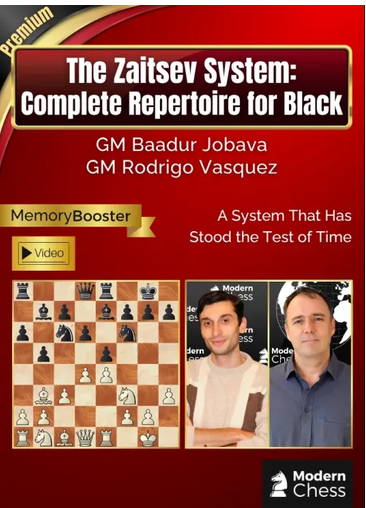
The Zaitsev System Complete Repertoire for Black PGN Only April 8, 2026
Original price was: $ 100.$ 5Current price is: $ 5.
OFF - 95%In stock

Description
Reviews (0)
Description
| Category | CHESS DATABASE |
|---|
The Zaitsev System: Complete Repertoire for Black
When Karpov needed to survive Kasparov’s prepared storms in their marathon matches, he turned to the Zaitsev. When Vachier-Lagrave and Firouzja need to fight for a win with Black against the Ruy Lopez, they reach for the same system.
Named after theoretician Igor Zaitsev, this variation has earned its place among the most resilient and ambitious defenses against 1.e4 — not through temporary fashion, but through decades of practical success at the highest level. GM Baadur Jobava and GM Rodrigo Vasquez have created a complete repertoire course that shows why this system remains a trusted weapon for elite players who refuse to settle for draws.
A Repertoire Built on Strategic Counterplay
The Zaitsev offers Black something rare in the Ruy Lopez: genuine counterplay from the opening moves. After 1.e4 e5 2.Nf3 Nc6 3.Bb5 a6 4.Ba4 Nf6 5.O-O Be7 6.Re1 b5 7.Bb3 d6 8.c3 O-O 9.h3 Bb7 10.d4 Re8, Black’s setup combines solidity with dynamic possibilities on both flanks. The fianchettoed bishop on b7, the flexible knight on c6, and the central tension create a position rich in strategic ideas — exactly what strong players want when they need to play for more than equality.
Jobava and Vasquez guide you through every critical White response. Their course doesn’t just show you the main lines — it covers the positional attempts like 12.d5 (Chapters 10-12), the aggressive 12.Ng5 (Chapter 2), the flexible 11.a4 (Chapters 8-9), and the prophylactic 12.a3 (Chapters 13-15). Each variation is examined with the same depth that elite players demand, showing not just what to play but why the positions work for Black.
The main battleground arrives after 11.Nbd2 Bf8 12.a4 h6 13.Bc2 exd4 14.cxd4 Nb4 15.Bb1 c5 16.d5 Nd7 17.Ra3 c4 — the critical tabiya where Black’s queenside counterplay meets White’s central ambitions. Chapters 5-7 dissect this position thoroughly, revealing the strategic balance that has made the Zaitsev a practical choice for world championship matches and elite tournaments alike.
Variation Map
The course is structured around White’s key decision points:
After 1.e4 e5 2.Nf3 Nc6 3.Bb5 a6 4.Ba4 Nf6 5.O-O Be7 6.Re1 b5 7.Bb3 d6 8.c3 O-O 9.h3 Bb7 10.d4 Re8:
- 11.Ng5 Rf8 12.Nf3 h6 — avoiding the repetition with winning chances → Chapter 1
- 11.a4 h6 — flexible move order with active counterplay → Chapters 8-9
- 11.a3 Bf8 — quiet continuation, balanced play → Chapter 16
- 11.Nbd2 Bf8 12.a4 h6 — entering the main theoretical lines
- 13.d5 (positional approach) → Chapters 10-12
- 13.a3 (prophylactic setup) → Chapters 13-15
- 13.Bc2 exd4 14.cxd4 — the main line
- 14.Nxd4 (rare recapture) → Chapter 4
- 14.cxd4 Nb4 15.Bb1 c5 16.d5 — critical positions → Chapters 5-7
- 12.Ng5 (aggressive attempt) → Chapter 2
- 12.Bc2 (immediate central control) → Chapter 3
Reviews (0)
Leave a Reply
You also like

Mega Database 2024 (PC) | Chess database 2024 | Chess Database
Original price was: $ 100.$ 5Current price is: $ 5. Quick ViewAdd to cart
POWERBOOK 2021 – ENGLISH CHESS OPENING
Original price was: $ 100.$ 5Current price is: $ 5. Quick ViewAdd to cart
CHESS DATABASE | ChessBase Italian Game Powerbook 2023
Original price was: $ 100.$ 5Current price is: $ 5. Quick ViewAdd to cart
Powerbase 2020 – Petroff Defence
Original price was: $ 100.$ 5Current price is: $ 5. Quick ViewAdd to cart
Sicilian Najdorf Powerbase 2022
Original price was: $ 100.$ 5Current price is: $ 5. Quick ViewAdd to cart
Powerbase 2020 – Scandinavian Defence
Original price was: $ 100.$ 5Current price is: $ 5. Quick ViewAdd to cart
Powerbase 2022 – Queen’s Gambit Declined
Original price was: $ 100.$ 5Current price is: $ 5. Quick ViewAdd to cart
Powerbase 2022 – Sicilian Paulsen
Original price was: $ 100.$ 5Current price is: $ 5. Quick ViewAdd to cart
Reviews
There are no reviews yet.